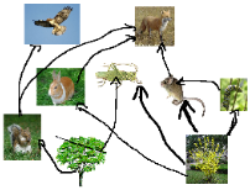
This is a food web of a typical grassland. The two plants on the bottom are the producers (the organisms who make their own food) The mouse, caterpillar, squirrel, rabbit, and grasshopper are the primary consumers (organisms who depend on plants for their food), and the fox and hawk are the secondary consumers (they are the ones who get their energy from other consumers). The primary consumers are herbivores, which means that they eat plants. The fox and the hawk are carnivores are the ones who eat meat. (Meng,1)
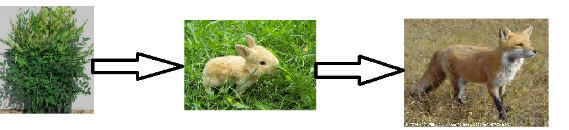
Below is a food chain. A food chain consists of usually 3 to 4 organisms. The first one is a producer, second is the primary consumer, third is the secondary consumer, and if present, the 4th is a tertiary consumer. The difference between a food web and a food chain is that a food chain consists of only one, while food webs contain multiple food chains. This food chain starts of with a fern as the producer, then the rabbit as the primary consumer, and then the fox as a secondary consumer. (Meng,1)
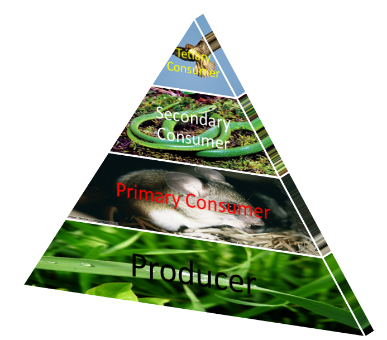
An energy pyramid is the last one of the 3 ways you can show energy passing in a biome. Each tier represents the amount of organisms in the population. There are way more producers than primary consumers, secondary consumers, and tertiary consumers. If there are 10,000 producers in the biome, there would be somewhere around 100 primary consumers, 10 secondary consumers, and 1 tertiary consumer.